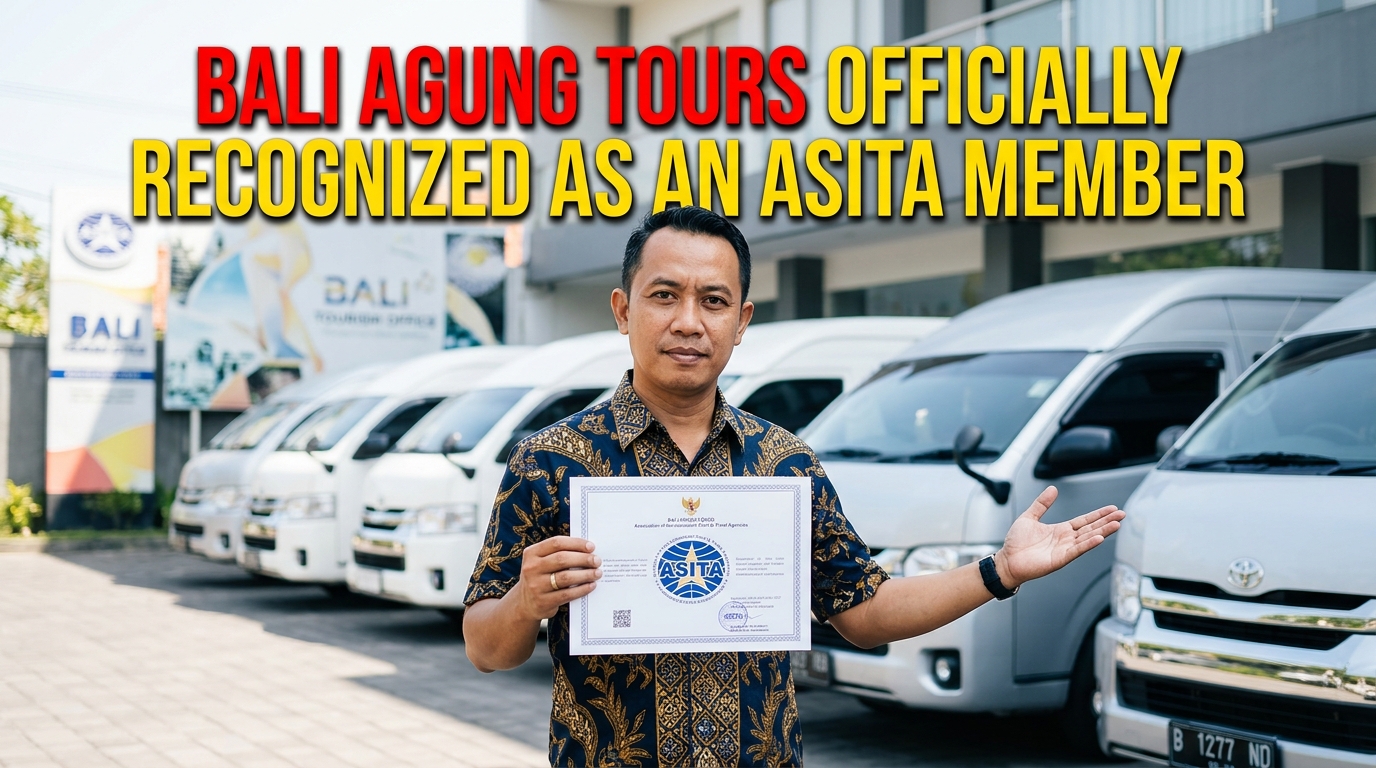
Bali Agung Tours has officially been recognized as a registered member of the Association of the Indonesian Tours and Travel Agencies (ASITA), the country’s primary regulatory body overseeing licensed tourism operators. The recognition formally places the company within Indonesia’s official tourism governance framework, a distinction that carries direct implications for how international clients, travel agencies, and individual travelers can now evaluate the reliability of their ground arrangements in Bali.
For clients booking through B2B travel agencies or arranging trips independently, ASITA membership isn’t a cosmetic badge tucked into a footer somewhere on a website. It represents verified compliance with a set of operational, legal, and safety standards that unregistered or informal operators simply aren’t held to, and it gives both agencies and travelers a concrete, third-party reference point when deciding who to trust with their ground logistics on the island.
What is ASITA and Why Does Membership Matter
ASITA, formally known as the Association of the Indonesian Tours and Travel Agencies, functions as the country’s primary industry body for licensed tourism operators. Established to bring structure and accountability to Indonesia’s rapidly growing tourism sector, the association sets baseline standards that member companies are expected to meet and maintain over time, not just at the point of initial registration.
A Filter Against Informal, Unregulated Operators
Bali’s tourism landscape includes a wide spectrum of ground operators, ranging from fully licensed, professionally run companies to informal freelance arrangements that operate with minimal oversight. ASITA membership functions as a filter, distinguishing operators who have submitted to formal verification from those who haven’t, which matters enormously for travelers trying to assess trustworthiness from thousands of kilometers away.
An Industry Body With Real Accountability Mechanisms
Unlike a self-issued certification or a marketing claim, ASITA membership involves ongoing accountability to an external association capable of investigating member conduct and addressing complaints. That structural difference is precisely what separates genuine regulatory recognition from a logo placed on a homepage.
What ASITA Membership Actually Verifies
ASITA membership requires operators to demonstrate legal business registration, adherence to Indonesia’s tourism regulations, and ongoing accountability to an industry body capable of investigating complaints. This structure exists specifically to separate legitimate, accountable operators from the loosely regulated freelance arrangements that have historically caused problems for foreign tourists, particularly those unfamiliar with how to distinguish a properly licensed provider from an informal one.
Legal Operational Guarantee
Membership confirms that Bali Agung Tours operates under Indonesia’s formal tourism licensing structure, meaning the company’s business practices, contracts, and client dealings are subject to regulatory oversight rather than operating in a legal gray zone. For international clients, this translates into a straightforward assurance: the entity they’re contracting with is a recognized, accountable business, not an informal arrangement with no legal standing.
Fleet Safety Standards
ASITA-affiliated operators are expected to maintain vehicle fleets that meet defined safety and maintenance benchmarks, reducing the risk of the breakdowns and roadworthiness issues sometimes associated with unregulated transport providers. Given Bali’s varied road conditions — from smooth coastal highways to steep, winding routes through the highlands near Kintamani and Munduk — fleet reliability directly affects both safety and the overall quality of a client’s trip.
Consumer Protection Framework
Should a dispute arise, clients working with an ASITA member have access to a formal complaint and mediation channel through the association, a layer of protection that simply doesn’t exist when booking through unregistered ground operators. This matters especially for B2B travel agencies, who carry ultimate responsibility to their own clients and need assurance that their ground partner operates within a framework offering genuine recourse if something goes wrong.
Commitment to Sustainable Tourism
ASITA membership also aligns operators with broader sustainable tourism principles that Indonesia’s tourism authorities have increasingly prioritized in recent years, encouraging practices that support local communities, respect cultural sites, and reduce environmental strain on Bali’s most visited destinations. As overtourism pressures on popular sites like Ubud and Uluwatu have drawn growing attention, operators aligned with these principles are increasingly viewed as better long-term partners for both travelers and the destinations themselves.
Why This Matters for International Clients and B2B Partners
Travel agencies vetting ground partners for their clients face a recurring challenge: verifying that a Bali-based DMC is actually operating within a legitimate, accountable framework rather than simply claiming to be reliable in marketing materials. ASITA membership provides an external, third-party verification point that agencies can independently confirm, rather than relying solely on an operator’s own representations about its legitimacy or standards.
A Reference Point Agencies Can Independently Verify
Because ASITA membership is externally recorded rather than self-declared, travel agencies can confirm a ground operator’s standing without depending entirely on that operator’s own claims. This independent verifiability is increasingly important as B2B partnerships expand across borders, where agencies often can’t physically inspect a ground operator’s fleet or facilities before committing to a partnership.
A Concrete Answer for Individual Travelers
For individual travelers, particularly those booking complex multi-day itineraries or premium ground packages, this recognition offers a concrete answer to a reasonable question: who is actually accountable if something goes wrong on the ground in Bali? Rather than relying on online reviews alone, which can be inconsistent or difficult to verify, travelers now have a formal registration status they can reference directly.
Growing Scrutiny Across the Industry
Industry observers have noted a broader shift toward tighter scrutiny of ground operators across Southeast Asia’s tourism markets, driven partly by rising traveler awareness and partly by regulatory bodies tightening enforcement around unlicensed transport and tour providers. Within that wider context, formal ASITA recognition positions Bali Agung Tours among operators actively meeting that rising bar rather than lagging behind it.
How This Affects Day-to-Day Client Experience
Beyond the regulatory significance, ASITA membership has practical implications for what clients can expect on the ground. Standardized fleet maintenance requirements, for instance, translate directly into fewer mechanical delays during multi-day itineraries. Formal accountability structures mean that driver conduct, vehicle condition, and service quality are subject to standards the company must actively maintain, not simply promise.
Fewer Logistical Surprises on Longer Itineraries
For travelers booking week-long circuits covering Ubud, Kintamani, and Nusa Penida transfers, fleet reliability compounds in importance with every additional travel day. A single breakdown can cascade into missed ferry connections or truncated sightseeing time, making the baseline safety standards tied to ASITA membership directly relevant to itinerary planning.
Clearer Expectations for B2B Agency Partners
Agencies structuring packages around Bali Agung Tours as a ground partner can now reference ASITA registration explicitly in their own client-facing materials, giving their customers an additional layer of reassurance that doesn’t rely purely on the agency’s own reputation.
Read also:
- Bali Tour Packages from Bangalore: Unplug in Ubud
- Bali Packages from Kerala: 2026 Customized Land Tour Itineraries
- Bali Tour Package 10 Days 9 Night All Inclusive
Looking Ahead
Bali Agung Tours stated that formal ASITA registration reflects an ongoing commitment to operating transparently within Indonesia’s tourism regulatory framework, and that the company intends to maintain the standards required to remain in good standing with the association going forward. The recognition arrives at a moment when both Indonesian regulators and international travel agencies are placing increasing weight on verifiable operational standards, rather than accepting marketing claims at face value.
As Bali’s tourism sector continues to expand, particularly among source markets like India where demand for structured, premium ground arrangements has grown steadily, formal regulatory recognition is likely to become an increasingly common differentiator between operators. For now, the ASITA registration gives Bali Agung Tours’ clients and partners a clear, externally verifiable point of trust heading into the year ahead.
Tags: Bali Agung Tours, ASITA Membership, Bali Ground Operator, Bali DMC, Indonesia Tourism Regulation, Bali Travel Safety, Bali Consumer Protection, Sustainable Tourism Bali, Bali Fleet Standards, Bali Travel Trust Signal